

The Garden of Epicurus
Paintings by Erietta Vordoni
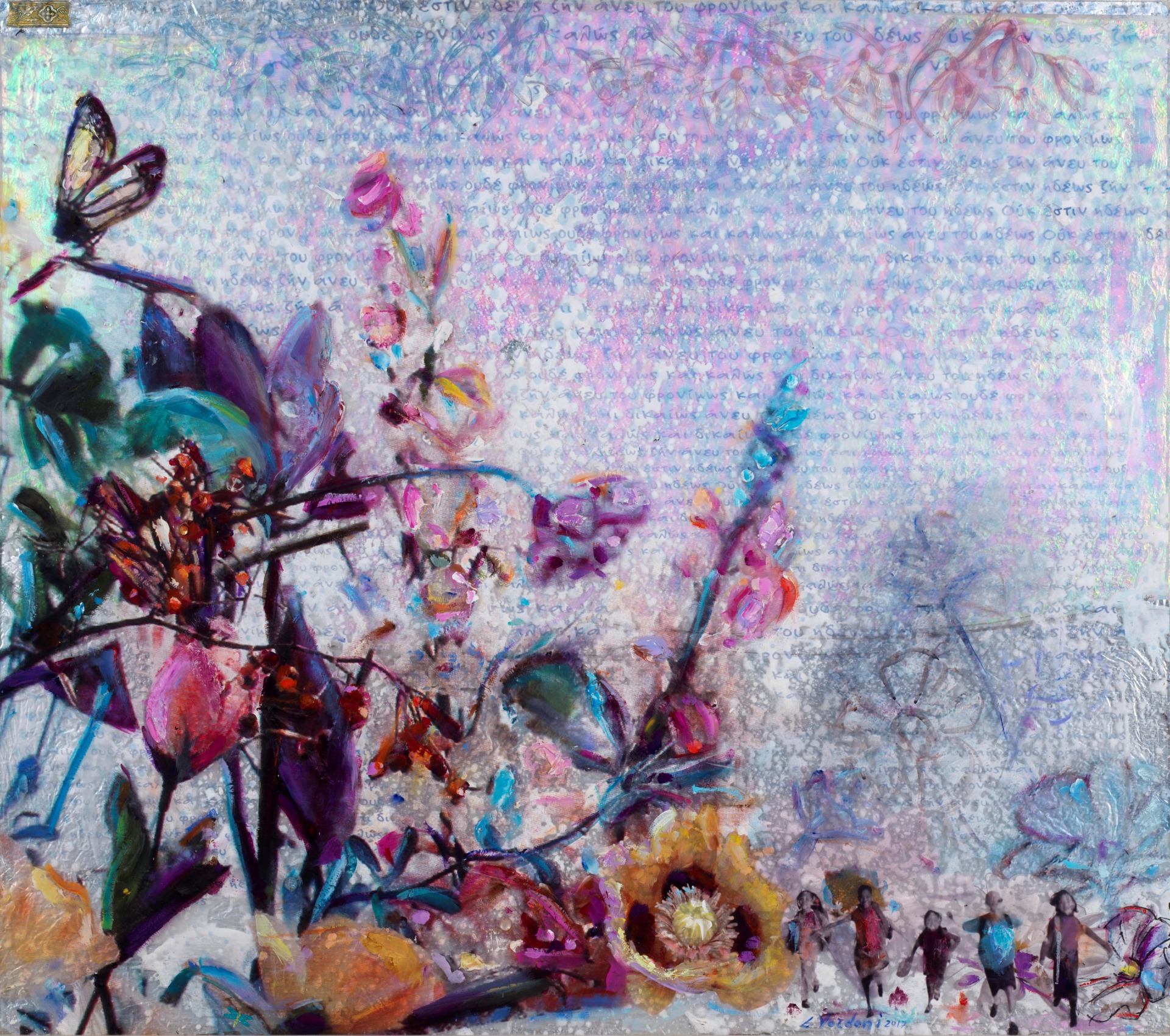
Exhibition of works by the distinguished painter Erietta Vordoni, titled “The Garden of Epicurus,” curated by art historian Theodoros Koutsogiannis.
Forty paintings compose the new solo exhibition of the distinguished painter Erietta Vordoni, titled “The Garden of Epicurus,” curated by art historian Theodoros Koutsogiannis.
This new body of work marks a mature moment in the artist’s creative journey, where matter, light and transparency become tools for inner exploration and spiritual balance.
The Artistic Proposal
Created using oil and mixed media, the works unfold through grids and translucent layers, forming multi-layered images that seem almost to breathe.
The use of plexiglass functions both structurally and symbolically: a field in which painting simultaneously contains and releases space, condensing “compressed air” and transforming it into visual energy.
Through diverse materials and gradations of cool tones, Vordoni constructs a dreamlike, almost suspended world in which matter appears to dissolve in dialogue with the immaterial. Cool tonal tensions transform into unexpected bursts of light, animating the surface of the works and giving them a sense of pulsating life.
Transparency acts as a passageway: the gaze enters, wanders, loses itself and returns, continually discovering new perspectives. In this way, the viewer is invited to compose a personal narrative and surrender to an experience of inner harmony — with the artwork, with its silence, and ultimately with oneself.
The Spirit of Epicurus
The exhibition’s title refers to the garden of the philosopher Epicurus as a place of serenity and spiritual self-sufficiency. In Vordoni’s painting, the Garden becomes a visual experience of balance: the pleasure of simplicity, the release from fear and the cultivation of friendship are reflected in the quiet harmony of forms and the pervasive sense of calm emanating from the works.
The artist proposes a space for contemplation where the aesthetic experience becomes a vehicle of well-being — a contemporary interpretation of Epicurean philosophy.
Curated by Theodoros Koutsogiannis
Theodoros Koutsogiannis, PhD in Art History and Curator of the Art Collection of the Hellenic Parliament, who curated the exhibition, notes:
The Garden of the Athenian philosopher Epicurus (341–270 BC), located outside the Dipylon Gate of Kerameikos, was open to the teaching of philosophy for everyone, regardless of gender, age, social or economic status. The Hellenistic period (323–31 BC) resembled our own era in many ways: multicultural, restless, unpredictable and individual-centred.
At the heart of Epicurean thought lies the concept of pleasure (hedone) — not in the sense of indulgence, but as the achievement of inner tranquility, guided by prudence, kindness and justice. The Garden of Epicurus sought freedom from pain and fear, through a self-sufficient life surrounded by friends.
These desiderata are also proposed by Erietta Vordoni, who creates her own Garden through painting. She invites us to experience a series of palimpsestic images with multiple layers and translucent strata of pictorial matter, composed with oil and diverse materials (metal, enamel, fabric) on plexiglass surfaces. The final pictorial result is also subject to the effect of light, which dramatically alters the visual perception of the works.
Vordoni’s distinctive and original painting, addressing a classical theme through a modern visual language, creates an artistic ensemble characterized by transparency, luminosity and captivating colour, bringing opposing elements into a fertile dialogue — a response to the contradictions of our contemporary world.
Her visual proposal becomes a personal worldview expressed through enchanting images, creating a virtual environment full of optimism and human affirmation, where the individual is harmoniously connected with the natural world.
In Vordoni’s visual interpretation, the Garden of Epicurus draws us into a dreamlike realm grounded in human measure and in dialogue with nature. As we wander through her Epicurean artistic garden, we surrender to the pleasure of colour, the optimism of light and the well-being of human creativity. Ultimately, Erietta offers us a poetic world of delight — one in which Epicurus himself would surely feel fulfilled.
A Painting Philosophy of Life
Erietta Vordoni’s work is distinguished by a positive spirit, a Zen-like balance and a deep belief in the healing power of art. This new series embodies precisely that attitude: a painting that does not seek tension but reconciliation — with oneself, with others and with the world.

INFO
-
Duration: 31 March - 15 July 2026
-
Daily 10:00 – 18:00
Τις ημέρες που έχει παράσταση στην αίθουσα Χ. Λαμπράκη η έκθεση θα παραμένει ανοιχτή μέχρι 20.30
The exhibition will remain closed from 9th – 14th April 2026 -
Exhibition space at ground level foyer Christos Lambrakis Hall
-
Free admission